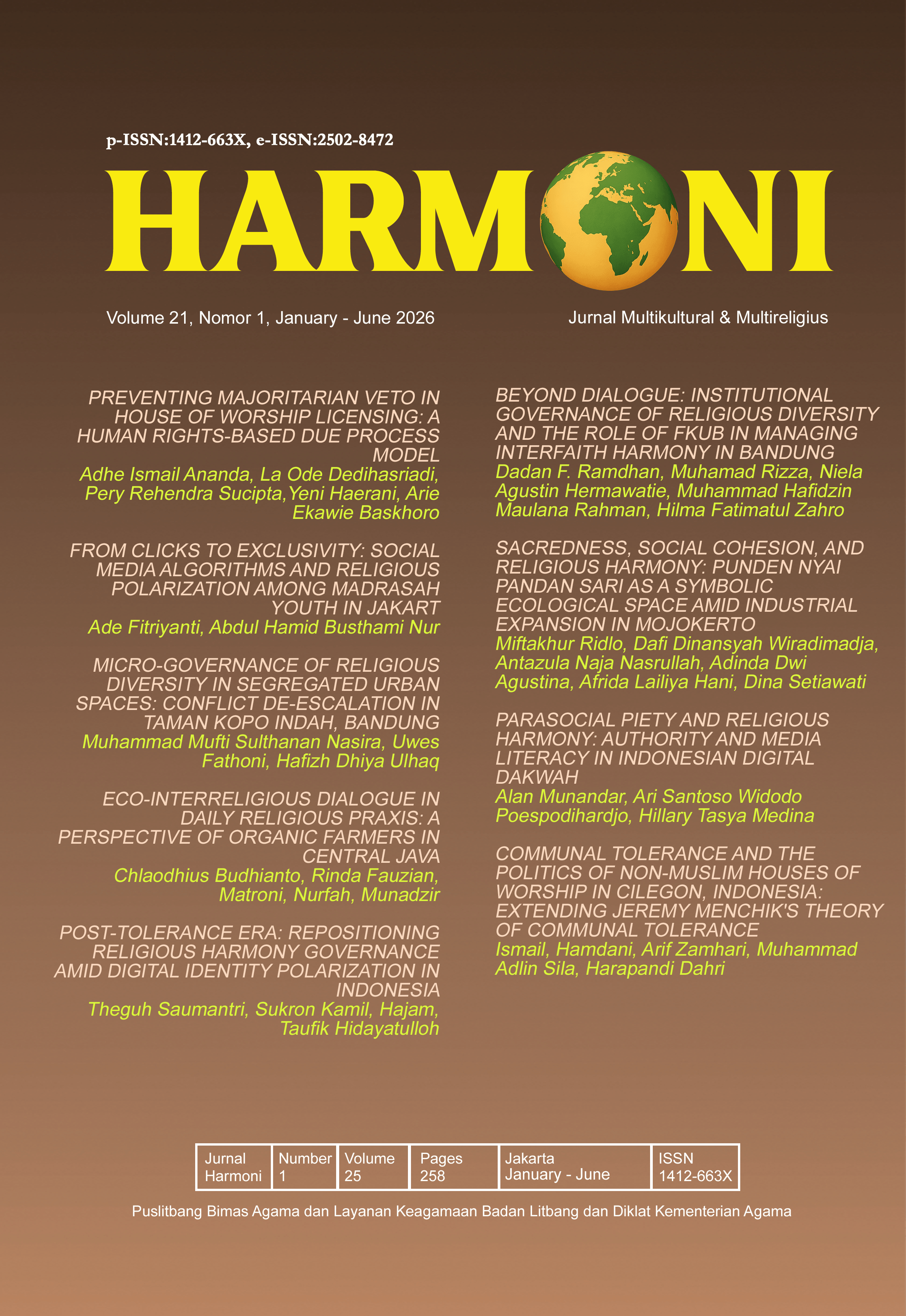
MICRO-GOVERNANCE OF RELIGIOUS DIVERSITY IN SEGREGATED URBAN SPACES: CONFLICT DE-ESCALATION IN TAMAN KOPO INDAH, BANDUNG
DOI:
https://doi.org/10.32488/harmoni.v25i1.983Keywords:
Perdamaian, Hubungan Antar Agama, Authority; Online Religion; Religion and Media; Religious AuthorityAbstract
This case study investigates the intermediary strategies employed by a local administrative authority in managing interfaith conflict within the spatially segregated residential community of Taman Kopo Indah, Bandung, Indonesia. Employing a qualitative intrinsic case study design with process tracing analysis, this research examines the de-escalation mechanisms activated following a mass congregation triggered by alleged blasphemy in a residential area characterized by demographic and religious divisions. While existing scholarship on Indonesian interfaith conflict resolution has largely centered on religious figures such as kiai and formal institutions such as the Religious Harmony Forum (FKUB), the role of secular local administrative actors as mediators within spatially segregated residential communities remains underexplored. Three primary informants were engaged: the Head of Neighborhood Unit (RW) 16, the leadership of the Persatuan Islam (Persis) Bojonghaur congregation, and the administrators of Baiturrahmaan Mosque. Drawing on Kriesberg’s Constructive Conflict theory, this case demonstrates the potential role of four tactical strategies in de-escalation: (1) Gatekeeping, which restricted external actor intervention; (2) Saving Face, through a symbolic public apology; (3) Information Filtering, by leveraging organizational command structures to halt the spread of inflammatory social media content; and (4) Re-framing, by redefining the incident as a medical rather than theological matter. This study suggests that in segregated urban spaces where formal religious mediators lack operational reach, secular local administrators may function as insider-partial mediators, offering an empirical framework for micro-level governance of religious diversity. However, the resulting stability constitutes negative peace rather than substantive interfaith integration.
Abstrak
Penelitian ini mengkaji strategi intermediary yang diterapkan oleh otoritas administratif lokal dalam mengelola konflik antaragama di komunitas Taman Kopo Indah yang tersegregasi secara spasial di Bandung, Indonesia. Menggunakan desain studi kasus intrinsik kualitatif dengan analisis process tracing, penelitian ini menelaah mekanisme de-eskalasi pascapengepungan massa yang dipicu dugaan penistaan agama di kawasan perumahan dengan kontras demografis dan keagamaan yang tajam. Meskipun kajian tentang resolusi konflik antaragama di Indonesia selama ini terfokus pada tokoh agama seperti kiai dan lembaga formal seperti Forum Kerukunan Umat Beragama (FKUB), peran otoritas administratif lokal yang sekuler sebagai mediator dalam komunitas perumahan tersegregasi secara spasial belum pernah dikaji secara memadai. Tiga informan utama dilibatkan: Ketua RW 16, pimpinan Jemaah Persatuan Islam (Persis) Bojonghaur, dan pengurus Masjid Baiturrahmaan. Berlandaskan teori Konflik Konstruktif Kriesberg, temuan mengungkap empat strategi taktis: (1) Gatekeeping, membatasi intervensi aktor eksternal; (2) Saving Face, melalui permintaan maaf simbolis di depan publik; (3) Penyaringan Informasi, memanfaatkan struktur komando organisasi untuk menghentikan penyebaran konten provokatif di media sosial; dan (4) Re-framing, mendefinisikan ulang insiden sebagai masalah medis, bukan teologis. Penelitian ini menyimpulkan bahwa administrator lokal sekuler dapat berperan sebagai mediator insider-partial yang efektif, menawarkan kerangka empiris tata kelola mikro keragaman beragama. Namun stabilitas yang tercipta merupakan perdamaian negatif yang dipertahankan melalui eksklusi sosial, bukan integrasi antaragama yang substantif.
Downloads
References
Agung, D. A. G., Nasih, A. M., Sumarmi, Idris, & Kurniawan, B. (2024). Local wisdom as a model of interfaith communication in creating religious harmony in Indonesia. Social Sciences & Humanities Open, 9, 100827. https://doi.org/10.1016/j.ssaho.2024.100827
Al-Mawardi, A. H. (1996). Al-ahkam al-sultaniyyah: The laws of Islamic governance (A. Yate, Trans.). Ta-Ha Publishers.
Al-Qaradawi, Y. (1994). The lawful and the prohibited in Islam (Al-halal wal-haram fil Islam). American Trust Publications.
Al-Raysuni, A. (2005). Imam al-Shatibi’s theory of the higher objectives and intents of Islamic law (N. Roberts, Trans.). International Institute of Islamic Thought.
Alhamuddin, & Alifuddin, M. (2024). Dynamics of interfaith communication in segregated communities. Jurnal Harmoni, 23(1), 18–34. https://doi.org/10.32488/harmoni.v23i1.532
Ambardi, K., Artosa, O. A., Dewi, N. P., & Yuliarso, K. Y. (2022). Social and virtual segregation: A study of gated communities in Yogyakarta. Masyarakat: Jurnal Sosiologi, 27(1), 27–52. https://doi.org/10.7454/MJS.v27i1.13551
Arif, M., & Lessy, Z. (2021). Another side of Balinese exoticism: Local wisdom of the Muslim community in Gelgel Village, Klungkung Regency, for preserving harmony between religious communities in Bali. INFERENSI: Jurnal Penelitian Sosial Keagamaan, 15(2), 185–216. https://doi.org/10.18326/infsl3.v15i2.185-216
Arifianto, A. R. (2022). Rising Islamism and the struggle for Islamic authority in Indonesia. Trans-Regional and National Studies of Southeast Asia, 10(1), 35–52. https://doi.org/10.1017/trn.2021.11
Azmi, M. (2022). Ajaran moral Tuan Guru dan pengaruhnya terhadap laku keberagamaan masyarakat Muslim Sasak dalam perspektif Islam dan sosiologi modern. Jurnal Harmoni, 21(2), 265–277. https://doi.org/10.32488/harmoni.v21i2.629
Burhani, A. N. (2021). The toxicity of sectarianism: The usage of khawarij and its impact on the Ahmadiyya community in Indonesia. Journal of Current Southeast Asian Affairs, 40(2), 244–263. https://doi.org/10.1177/1868103421993141
Conrad, P. (1992). Medicalization and social control. Annual Review of Sociology, 18, 209–232.
Coser, L. A. (1956). The functions of social conflict. Free Press.
Erawadi, E., & Setiadi, F. M. (2024). Exploring religious harmony through Dalihan Na Tolu: Local wisdom in peacebuilding in Indonesia. Jurnal Ilmiah Peuradeun, 12(3), 1379–1408. https://doi.org/10.26811/peuradeun.v12i3.1398
Galtung, J. (1996). Peace by peaceful means: Peace and conflict, development and civilization. Sage Publications.
Goffman, E. (1959). The presentation of self in everyday life. Anchor Books.
Hanifah, N. A. N. (2023). Interaksi sosial antarumat beragama di Kelurahan Kingking, Tuban. Jurnal Harmoni, 22(1), 187–207. https://doi.org/10.32488/harmoni.v1i22.604
Hapsin, A. (2022). Walisongo and the notion of abrasive strategies in countering radicalism in Indonesia. Walisongo: Jurnal Penelitian Sosial Keagamaan, 30(2), 215–240. https://doi.org/10.21580/ws.30.2.14066
Hernawan, W., Riyani, I., & Busro, B. (2021). Religious moderation in naskah wawacan babad walangsungsang: A Sundanese religious diversity wisdom. HTS Teologiese Studies, 77(4), a6773. https://doi.org/10.4102/hts.v77i4.6773
Hilmy, M. (2020). The politics of being moderate: The Nahdlatul Ulama and the state in modern Indonesia. Journal of Indonesian Islam, 14(2), 283–312. https://doi.org/10.15642/JIIS.2020.14.2.283-312
Ibn Rushd. (2000). Bidayat al-mujtahid wa nihayat al-muqtasid: The distinguished jurist’s primer (I. A. K. Nyazee, Trans.). Garnet Publishing.
Jati, W. R. (2023). The religious moderation for Indonesia Muslim middle class: Challenges and solutions. Penamas, 36(1), 19–36. https://doi.org/10.31330/penamas.v36i1.647
Jubba, H., Awang, J., Qodir, Z., Hannani, & Pabbajah, M. (2022). The contestation between conservative and moderate Muslims in promoting Islamic moderatism in Indonesia. Cogent Social Sciences, 8(1). https://doi.org/10.1080/23311886.2022.2116162
Kresna, A. A., Wiloso, P. G., Therik, W., & Toisuta, W. (2025). Brokerage and social segregation: A case study of cluster housing environment in Gading Serpong, Indonesia. Southeast Asia: A Multidisciplinary Journal, 25(1), 3–15. https://doi.org/10.1108/SEAMJ-06-2023-0051
Kriesberg, L., & Dayton, B. W. (2012). Constructive conflicts: From escalation to resolution (4th ed.). Rowman & Littlefield.
Lederach, J. P. (1997). Building peace: Sustainable reconciliation in divided societies. United States Institute of Peace Press.
Maknun, L. (2020). Kontestasi kerukunan umat beragama di kaki Pura Arga Sunya. Jurnal Harmoni, 19(1), 28–48. https://doi.org/10.32488/harmoni.v19i1.413
Manuain, L. M. M., Mila, S., & Takoi, I. Y. (2024). Beyond religious tolerance: Reflecting the interfaith women’s dialogue. Penamas, 37(1), 1–14. https://doi.org/10.31330/penamas.v37i1.743
Maulana, F., Rohman, B., Abidin Riam, Z., & Juraidi, A. (2023). Peran masjid dalam penyebaran toleransi: The role of mosques in spreading tolerance. Jurnal Bimas Islam, 16(2), 397- 420. https://doi.org/10.37302/jbi.v16i2.1080
Mayer, B. (2012). The dynamics of conflict resolution: A practitioner’s guide. Jossey-Bass.
Menchik, J. (2016). Islam and democracy in Indonesia: Tolerance without liberalism. Cambridge University Press.
Mietzner, M. (2018). Fighting illiberalism with illiberalism: Islamist populism and democratic deconsolidation in Indonesia. Pacific Affairs, 91(2), 261–282. https://doi.org/10.5509/2018912261
Mietzner, M., & Muhtadi, B. (2020). The myth of pluralism: Nahdlatul Ulama and the politics of religious tolerance in Indonesia. Contemporary Southeast Asia, 42(1), 58–84. https://doi.org/10.1355/cs42-1c
Mulya, T. W., & Schäfer, S. (2023). Who belongs where? Geographies of (inter)religion and urban segregation in Surabaya, Indonesia. Cities, 141, 104476. https://doi.org/10.1016/j.cities.2023.104476
Nugroho, N. D., Rabitha, D., & Ismail. (2023). Preventing radicalism through religious moderation. Penamas, 36(2), 250–265. https://doi.org/10.31330/penamas.v36i2.678
Parwanto, W., Sahri, Busyara, S., Riyani, & Nadhiya, S. (2022). Religious harmonization on ethno-religious communities of Muslim and Dayak Katab-kebahan in Tebing Karangan Village, Melawi District, West Kalimantan. Jurnal Harmoni, 21(2), 184–200. https://doi.org/10.32488/harmoni.v21i2.638
Qodir, Z., Jubba, H., Hidayati, M., Abdullah, I., & Long, A. S. (2021). [Full citation to be verified by the authors against their original source for the concept of ‘digital jihadism’].
Perbawasari, S., Sjoraida, D. F., Anisa, R., Bakti, I., & Subekti, P. (2023). Communication and cultural inheritance through a traditional school in Dangiang Village Garut. Jurnal Kajian Komunikasi, 11(1), 18–30. https://doi.org/10.24198/jkk.v11i1.45121
Roitman, S., & Recio, R. B. (2020). Understanding Indonesia’s gated communities and their relationship with inequality. Housing Studies, 35(5), 795–819. https://doi.org/10.1080/02673037.2019.1636002
Rouf, A. (2020). Penguatan landasan teologis: Pola mewujudkan moderasi kehidupan beragama. Jurnal Bimas Islam, 13(1), 105–140. https://doi.org/10.37302/jbi.v13i1.148
Shoemaker, P. J., & Vos, T. P. (2009). Gatekeeping theory. Routledge. https://doi.org/10.4324/9780203931653
Suhadi, S. (2020). The role of FKUB in managing religious conflict in Indonesia: Challenges and opportunities. Al-Jami’ah: Journal of Islamic Studies, 58(1), 1-30. https://doi.org/10.14421/ajis.2020.581.1-30
Syihab, A. (2023). Otoritas kiai kampung dan resolusi konflik: Menjembatani kesenjangan antara teks dan konteks. Studia Islamika, 30(1), 1-25. https://doi.org/10.36712/sdi.v30i1.28000
Tajib, F. (2021). Tolerance without acceptance: The politics of ‘harmony’ in Indonesia. Journal of Southeast Asian Studies, 52(1), 89-110. https://doi.org/10.1017/S0022463421000023
Ting-Toomey, S. (2005). The matrix of face: An updated face-negotiation theory. In W. B. Gudykunst (Ed.), Theorizing about intercultural communication (pp. 71-92). Sage.
Waluyajati, R. S. R. (2022). Religious segregation in rural urban community: The experiences from Cihampelas District, Indonesia. Khazanah Sosial, 4(4), 765-780. https://doi.org/10.15575/ks.v4i4.23647
Yahya, I., & Susilo, S. (2024). Conservative Muslims in Indonesia’s religious and political landscapes: Ahok’s blasphemy case as a political leverage. Cogent Social Sciences, 10(1), 2392293. https://doi.org/10.1080/23311886.2024.2392293
Zuhrah, F., & Yumasdaleni. (2021). Masjid, moderasi beragama dan harmoni di kota Medan. Jurnal Harmoni, 20(2), 291–316. https://doi.org/10.32488/harmoni.v20i2.512
Downloads
Published
Issue
Section
License
Copyright (c) 2026 Muhammad Mufti Sulthanan Nasira, Uwes Fathoni, Hafizh Dhiya Ulhaq

This work is licensed under a Creative Commons Attribution-NonCommercial-ShareAlike 4.0 International License.